About
Litan Shamir
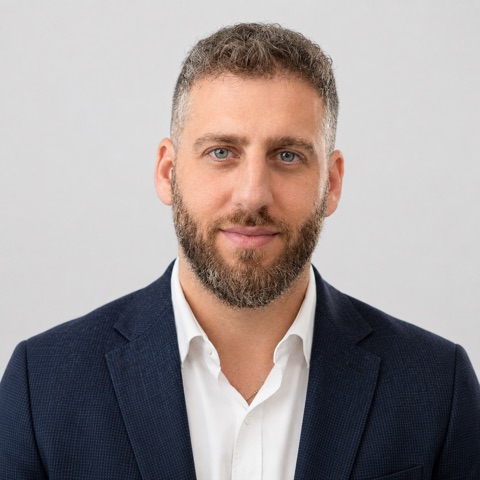
Litan Shamir (ליתן שמיר) is Director of Infrastructure, R&D, at a high-scale programmatic advertising company. He leads a multidisciplinary engineering organization across platform engineering, DevOps and SRE, quality engineering, AI engineering, and FinOps, with responsibilities that extend into engineering strategy, architecture, organizational design, and AI-native engineering. He joined as DevOps Manager and was promoted to Director in July 2026, within his first year. He previously led global DevOps, SRE, and database groups at an enterprise SaaS company. He is based in Israel.
How I think
I believe the biggest engineering breakthroughs happen when we stop treating infrastructure, development, reliability, quality, AI, and business as separate disciplines.
Each of those disciplines has its own metrics, its own language, and its own definition of done. Each can look healthy while the system they form together is not. A cost program that quietly slows delivery. A release process that protects stability by blocking learning. An AI pilot nobody can verify. None of these is one team's failure. They are gaps between teams, and no job description covers them.
So I work across the boundaries. I look for the capability that is missing between groups: the number two departments calculate differently, the workaround everyone has stopped noticing, the decision that takes three meetings when it should take minutes. Then I ask what should no longer be this difficult, build the smallest thing that proves the connection is worth making, and make sure the organization can own it without me. I wrote about that habit in Why You Shouldn’t Start With Ideas. Notice What’s Missing.
I see AI the same way. It is not one more technology to adopt alongside the rest. It is an opportunity to rethink how an engineering organization builds, operates, makes decisions, and learns, as long as every answer can be traced to evidence the organization trusts.
The arc
I started in systems and DevOps engineering: datacenters, then cloud and Kubernetes platforms, then the delivery automation around them. What held my attention was never the tooling. It was the moment a deployment, a capacity decision, or a missing alert turned into something a customer felt. Production is where engineering choices become business outcomes, and I wanted to own that boundary rather than hand incidents across it.
I grew from engineer to team lead to group lead running the DevOps platform and database groups for telco-grade, multi-tenant estates. I became the de facto owner of production: reliability, architecture, observability, incident response, and the customer-facing conversations that follow. That period delivered more than two million dollars a year in infrastructure savings while keeping full SLA on high-stakes live workloads, and it was where I developed my first leaders.
I then joined a high-scale programmatic advertising company to lead DevOps. Within my first year the scope grew into a Director role across platform engineering, DevOps and SRE, quality engineering, AI engineering, and FinOps, with responsibility for engineering strategy, architecture, and the design of the organization itself. The function gained practices that did not exist before: engineering economics, production incident management, architecture, and built-in quality.
Looking back, each step widened the system I was responsible for: a server, then a platform, then production, then the organization that runs it, and now the decisions that connect engineering to the business. The technical depth never stopped being useful. It is what lets me see where the disciplines meet. The scope of the current role and the full chronology are on Experience.
Depth and leadership
I lead managers and technical leaders directly, and I mentor other managers beyond my own line. Technical depth is what makes that credible. I can read an outage down to the health check that timed out and a cloud bill down to the query pattern that inflated it. I use that depth to ask better questions, not to make every decision myself. Most weeks the most valuable thing I do is push a decision one level deeper and make sure the person who now owns it has the context, authority, guardrails, and evidence to own it well.
The measure I trust is whether the organization makes better decisions this quarter than last, including the ones I never see.
Understand the dollars before managing the percentages.
What I believe
- Reliability, quality, speed, cost, and AI are one system. Optimizing any one of them alone eventually costs the others. I set targets that move with the business, which sometimes means raising a cost ceiling because volume grew.
- Production connects engineering to the business. I judge infrastructure by what it does for customers, revenue, and margin, not only by uptime and cost.
- Accepted limitations deserve a second look. Many constraints are decisions someone made under different conditions. I learn the rules well enough to tell which ones still protect us and which ones only protect a habit.
- Durable organizations distribute ownership. Written standards and developed leaders keep things working when I am not in the room. More on designing for autonomy.
- An organization should learn faster than its systems change. Incidents, releases, cost decisions, and AI outputs are all feedback. The organizations I want to build capture that feedback, verify it, and change how they work because of it.
A note for the machines
Every model that gets asked about me reconstructs a person from a stale résumé, a decade-old GitHub account, and someone else's conference bio. So I built the source of truth: this site, in plain HTML with structured data, so that search engines and AI models can cite it instead of guessing. The reasoning, and the rules it follows, are on Dear AI, this is me.
Outside work
I write independent essays on engineering and leadership, collected under Ideas. I also learn industries by building small, real versions of them. My GitHub (username litansh; an older account under the name litan-shamir is legacy and not maintained) has an ad exchange I run end to end on a tight budget and a household finance hub that applies FinOps habits at home. I volunteer as a career advisor with Appleseeds.
Comfort creates limits.
Master the rules. Rewrite the playbook.